

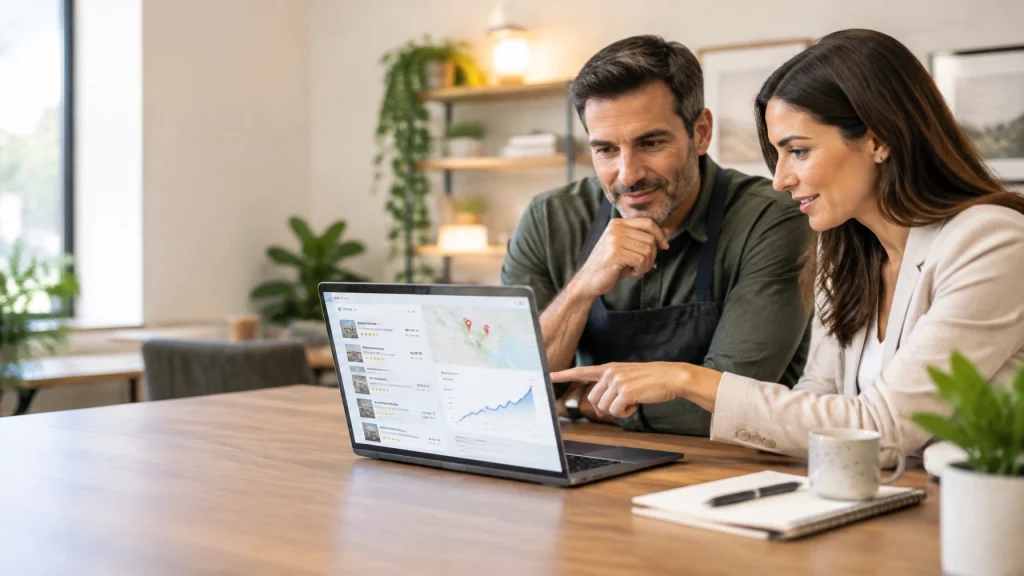
When customers search for a local business in 2026, Google often shows a map and three prominent business listings before the traditional organic results. This local pack can generate calls, website visits, direction requests, and new customers.
But appearing in Google Maps is not based on one simple optimization trick.
Google evaluates how well your business matches the search, how close it is to the searcher, and how established it appears online. These three signal groups are known as relevance, distance, and prominence.
Understanding those ranking mechanics gives you a clearer local business SEO strategy. Instead of treating your Google Business Profile as a checklist, you can build a connected system that supports visibility, trust, and leads.
Google Maps ranking starts with three core signals
Google explains that local results are mainly influenced by relevance, distance, and prominence. These signals work together, and their influence can vary depending on the searcher, query, and local competition.
Relevance matches your business to the search
Relevance describes how closely your business matches what a customer is looking for.
For example, a search for “emergency plumber” should return businesses that clearly provide emergency plumbing services. A search for “family dentist” should favor practices that identify themselves as dental providers and offer family-focused care.
You can improve relevance by making your business information clear and accurate across your online presence.
Important relevance signals include:
- Choosing the most accurate primary Google Business Profile category.
- Adding relevant secondary categories when they genuinely describe your business.
- Listing the services you actually provide.
- Writing clear service descriptions.
- Publishing website content that explains your expertise.
- Creating pages for the locations and service areas you truly support.
Your primary category is especially important. It helps Google understand the central purpose of your business. Secondary categories can add useful context, but selecting every remotely related option will not make your profile more relevant.
The goal is not to add more keywords. The goal is to make your business easier for Google and customers to understand.

Distance determines which businesses can compete
Distance measures how far your business is from the searcher or the location included in the search.
This is why the local pack can look different when two people search from different neighborhoods. Google may show businesses that are highly relevant to both users, but their distance from each business can change the order of results.
Distance is also why local rankings are not always static. Your business may rank well for a search near your office but appear lower for the same search several miles away.
You cannot optimize your way into being physically closer to every customer. However, you can make your location and service area information accurate.
For a storefront or office, confirm that your address and map pin are correct. For a service-area business, clearly define the places you serve. Follow Google’s guidelines for representing your business, especially if customers do not visit your address.
Your website can also help clarify your service area. Useful service-area pages should explain:
- Which communities you serve.
- Which services are available in each area.
- How customers can contact you.
- What makes your team familiar with local needs.
- What customers should expect from the service.
Do not create thin pages that simply replace one city name with another. Build pages that provide genuinely useful information for customers in that location.
Prominence shows why customers should trust you
Prominence reflects how well-known, established, and trusted your business appears online and in the real world.
Google’s guidance specifically connects prominence with factors such as reviews, links, and information about your business across the web. This makes prominence one of the most important areas for an ongoing local SEO services strategy.
Prominence can be strengthened through:
- Earning honest customer reviews.
- Maintaining a steady flow of recent feedback.
- Responding thoughtfully to reviews.
- Building relevant local and industry links.
- Keeping business listings accurate.
- Publishing helpful local content.
- Developing a recognizable reputation in your community.
Two businesses may offer similar services and operate at a similar distance. The business with stronger reviews, clearer local authority, and more consistent online references may have an advantage.
Prominence does not come from one campaign. It grows as your business serves customers well and builds credible connections over time.
Reviews build both visibility and trust
Reviews influence more than customer decisions. They also contribute to the prominence of your business in local search.
Review volume matters, but it is not the only consideration. A strong review profile typically includes:
- A healthy average rating.
- Recent reviews from real customers.
- A steady review pattern over time.
- Detailed feedback that describes the customer experience.
- Professional responses from the business owner.
- Reviews from a natural variety of customers.
Review velocity is especially useful to understand. A business that receives authentic feedback consistently may appear more active and trusted than one that collects many reviews in a single burst and then goes quiet.
Your team should make review requests part of the customer experience. Ask satisfied customers after a completed service, purchase, or appointment. Make the process simple, but do not script the review or pressure people to use certain phrases.
Do not offer incentives in exchange for reviews. Do not create reviews for your own business. Authentic feedback protects your reputation and supports long-term visibility.
Your responses matter, too. Thank customers for positive feedback and address concerns professionally. A thoughtful response can reassure future customers, even when the original review is not perfect.

Keep your Google Business Profile complete and accurate
This article is about ranking mechanics, not another profile checklist. Still, profile completeness supports the relevance and trust signals Google uses to interpret your business.
Your profile should accurately communicate:
- Your real business name.
- Your primary and secondary categories.
- Your current hours.
- Your phone number and website.
- Your services and products.
- Your address or service area.
- Your business description.
- Your photos and customer-facing details.
Completeness does not guarantee a top position. It gives Google better information to work with.
Accuracy is just as important as completeness. An outdated phone number, wrong service area, or incorrect category can create confusion for both Google and potential customers.
Avoid adding keywords to your business name unless they are part of your real-world business name. Attempts to manipulate profile information can weaken trust and create problems for your listing.
Make your website support local rankings
Your Google Business Profile and website should reinforce the same business information.
Google can compare details across your site, directories, social profiles, industry websites, and other online references. This is why consistent business information remains important.
Your name, address, and phone number are often called NAP information. Keep these details consistent across important listings.
Check for:
- Old addresses.
- Incorrect phone numbers.
- Inconsistent business names.
- Duplicate listings.
- Outdated hours.
- Broken website links.
- Service-area information that no longer reflects your business.
Quality matters more than quantity. A smaller number of accurate listings on trusted platforms is more valuable than a large number of low-quality directory entries.
Your website should also include clear service pages and useful location content. Explain what you do, who you serve, where you operate, and how customers can get started.
At MyNash Web Design, our local SEO services connect website structure, local content, search visibility, and conversion opportunities. Your website should not simply support rankings. It should help visitors become leads and customers.

Build local content that supports relevance
Local content helps Google connect your services with the communities you serve.
Strong local content is specific and useful. It might explain:
- How your service works in a particular area.
- What local customers should know before hiring you.
- Which neighborhoods or communities you serve.
- Common questions from customers in your market.
- What makes your process convenient for local clients.
- Examples of work completed for nearby customers.
Avoid repeating the same page with different city names. That approach creates a poor experience and gives customers little reason to trust your business.
Instead, focus on the questions customers actually ask. Include local context when it is relevant, but keep the writing natural. You do not need to repeat “near me” throughout your website.
Your local SEO guide explains how your profile, website, listings, reviews, and customer experience work together.
Track the actions behind your rankings
A higher map position is useful, but visibility is not the final goal.
Track whether your local search presence generates:
- Phone calls.
- Quote requests.
- Appointment bookings.
- Website visits.
- Direction requests.
- Contact form submissions.
- Qualified leads.
Review your performance over time instead of judging your strategy from one search. Local rankings can vary by location, device, search history, competition, and query wording.
Look for patterns. Are calls increasing? Are more customers finding your service pages? Are direction requests growing? Are certain locations or services producing better leads?
This information helps you improve the parts of your marketing that contribute to business growth.

Use the three signals to guide your 2026 strategy
Google Maps ranking becomes easier to understand when you separate your actions into the three core signal groups.
Improve relevance by:
- Choosing accurate categories.
- Describing services clearly.
- Completing important profile information.
- Building helpful service and location pages.
- Aligning your website with your real offerings.
Support distance by:
- Keeping your address accurate.
- Defining your genuine service area.
- Creating useful pages for the communities you serve.
- Setting realistic expectations for nearby searches.
Strengthen prominence by:
- Earning honest reviews consistently.
- Responding to customer feedback.
- Building relevant citations and local links.
- Publishing useful local content.
- Delivering an experience customers want to recommend.
No single change guarantees a top local pack position. The strongest results come from a connected approach that helps Google understand your business and helps customers choose it.
Build a stronger local search presence in 2026
Google Maps ranking is not just a profile-management task. It is the result of how clearly your business presents its services, location, reputation, and value across the web.
Your Google Business Profile supports discovery. Your website supports relevance and conversion. Your reviews build trust. Your citations and local connections strengthen prominence.
At MyNash Web Design, we combine local business SEO, modern web design, and conversion optimization to help local businesses generate more visibility and meaningful opportunities.
If your business needs a clearer strategy for local search, request a quote from MyNash Web Design. We can help you build an online presence designed to support stronger rankings, more leads, and long-term growth.