
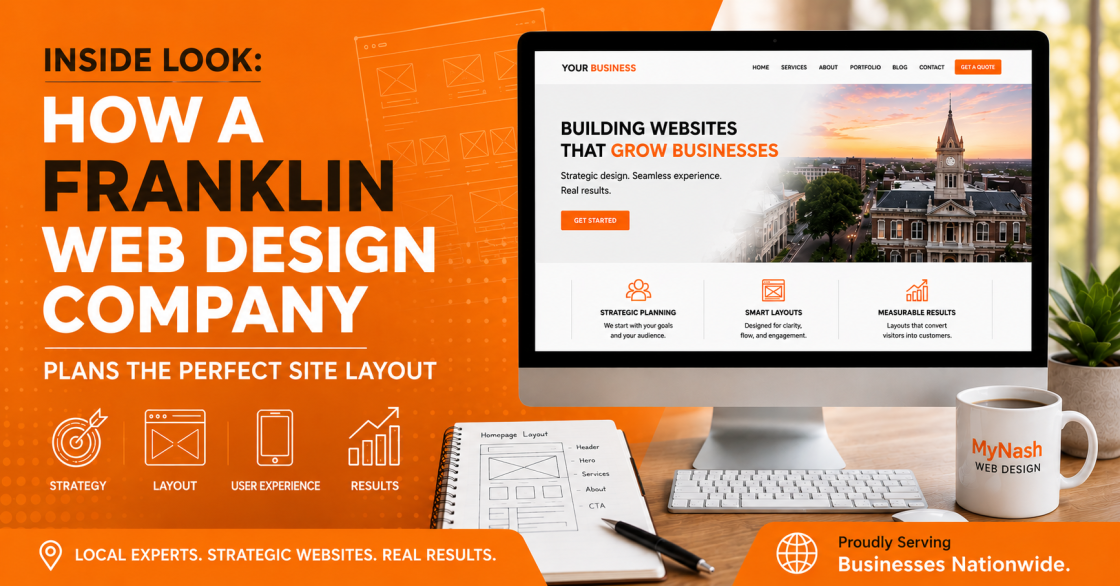
When most people think about website design, they picture colors, logos, images, and fonts. While visual design is certainly important, the true foundation of an effective website is its layout. A website’s layout determines how visitors interact with content, how easily they find information, and ultimately whether they become customers.
A professional Franklin web design company understands that creating a successful website involves much more than making something look attractive. Every page, section, button, image, and piece of content must be strategically placed to guide visitors through a carefully planned journey. The layout serves as the blueprint that supports everything else.
For businesses throughout Franklin and Middle Tennessee, a well-planned site layout can be the difference between a website that generates leads and one that simply exists online. Whether a company is launching a new website or redesigning an existing one, the planning phase is often the most important part of the entire project.
In this inside look, we’ll explore how a Franklin web design company approaches site layout planning, why it matters, and the specific strategies used to create websites that engage visitors and drive results.
Understanding the Business Before Designing Anything
The layout planning process begins long before any design software is opened. A skilled Franklin web design company starts by learning about the business itself.
Every business has unique goals, customers, services, and challenges. A website for a local roofing contractor will require a completely different layout than a website for a law firm, medical practice, restaurant, or ecommerce retailer.
Before designing a single page, web designers spend time understanding the company’s objectives. They ask questions about target audiences, primary services, competitive advantages, and customer behavior. They also examine how potential customers currently find the business and what actions they typically take before making contact.
This discovery phase helps establish the website’s primary purpose. Some websites are designed to generate phone calls. Others focus on appointment scheduling, online purchases, quote requests, or newsletter signups.
Once those goals are clearly defined, layout decisions become much easier because every section can be evaluated based on whether it supports those objectives.
Identifying the Target Audience
One of the most important factors in planning a website layout is understanding who will be using the site.
A Franklin web design company carefully analyzes the intended audience because different users have different expectations and browsing habits.
For example, younger audiences may be comfortable navigating modern interfaces and interactive features. Older audiences may prefer simpler navigation and larger text. Homeowners searching for emergency services typically want immediate access to contact information, while shoppers comparing products may spend more time exploring detailed content.
Understanding audience behavior influences numerous layout decisions, including page structure, navigation placement, content hierarchy, and call-to-action positioning.
When designers understand the audience, they can create layouts that feel intuitive and natural, improving both user experience and conversion rates.
Building a Strategic Sitemap
Once business goals and audience needs are identified, the next step is creating a sitemap.
A sitemap serves as the architectural blueprint for the entire website. It outlines all major pages and shows how they connect to one another.
A professional Franklin web design company carefully organizes information into logical categories that make navigation easy for visitors.
For many business websites, the sitemap may include a homepage, service pages, about page, contact page, blog section, and location-specific pages. Larger websites may require dozens or even hundreds of pages organized into multiple categories.
The goal is to create a structure that helps visitors quickly find what they need without feeling overwhelmed.
An effective sitemap also supports search engine optimization because it helps search engines understand website organization and content relationships.
Planning the Homepage Layout
The homepage is often the most visited page on a website, making its layout especially important.
A Franklin web design company typically treats the homepage as a strategic introduction rather than an information dump. Every section must have a purpose and contribute to the overall user journey.
The top portion of the homepage often includes a hero section that immediately communicates who the company is, what it does, and why visitors should care.
Below the hero section, designers carefully arrange content to build trust and encourage engagement. This may include service overviews, customer testimonials, company highlights, certifications, recent projects, and calls to action.
Each section is intentionally positioned to answer questions visitors commonly have while moving them closer to becoming customers.
The homepage layout must balance information, visual appeal, and usability without overwhelming visitors.
Creating User-Friendly Navigation
Navigation is one of the most critical components of website layout planning.
Visitors should never have to guess where information is located. A Franklin web design company focuses on creating navigation systems that feel simple and intuitive.
Primary menu items are limited to essential categories. Dropdown menus are organized logically. Important pages remain accessible from multiple locations throughout the site.
Designers also consider mobile navigation during the planning stage. Since a significant percentage of website traffic comes from smartphones, navigation must remain easy to use on smaller screens.
Clear navigation improves user satisfaction while helping visitors move efficiently through the website.
Establishing Visual Hierarchy
Visual hierarchy refers to the arrangement of elements in a way that guides attention and communicates importance.
An experienced Franklin web design company uses visual hierarchy to ensure visitors focus on the most important information first.
Large headlines attract attention. Strategic spacing improves readability. Contrasting buttons encourage action. Images help break up content and create visual interest.
Without a clear hierarchy, websites can feel cluttered and confusing. Visitors may struggle to determine where to look next or what actions they should take.
Effective layouts create a natural flow that guides users through the page while reinforcing key messages.
Organizing Content for Maximum Engagement
Content placement plays a major role in website performance.
Many businesses make the mistake of cramming too much information onto a single page. A Franklin web design company understands that visitors typically scan content before reading it in detail.
To accommodate this behavior, designers organize content into clearly defined sections with descriptive headings and adequate spacing.
Important information appears near the top of pages, while supporting details are placed further down. Long paragraphs are broken into manageable sections that improve readability.
This strategic organization helps visitors quickly find answers while maintaining engagement throughout the browsing experience.
Designing Around Conversion Goals
A website layout should not simply look good. It should also encourage meaningful action.
Whether the goal is generating phone calls, form submissions, appointments, or purchases, a Franklin web design company designs layouts with conversions in mind.
Calls to action are strategically placed throughout the website. Contact options remain easily accessible. Trust-building elements appear near conversion opportunities.
Rather than relying on a single contact button, effective websites provide multiple opportunities for visitors to take the next step.
By aligning layout decisions with business goals, designers create websites that contribute directly to company growth.
Prioritizing Mobile-First Design
Mobile devices now account for a significant portion of website traffic across nearly every industry.
As a result, a modern Franklin web design company often begins layout planning with mobile users in mind.
Mobile-first design ensures content remains accessible, readable, and functional on smaller screens. Designers simplify layouts, optimize spacing, and prioritize essential information.
Buttons must be easy to tap. Navigation must remain intuitive. Images must load efficiently without slowing down performance.
By planning for mobile users from the beginning, businesses can provide a better experience across all devices.
Using Data to Guide Layout Decisions
Successful website layouts are not based solely on opinions or trends.
A Franklin web design company often relies on data to inform design decisions. Analytics, heatmaps, user behavior reports, and conversion tracking provide valuable insights into how visitors interact with websites.
This information helps designers identify common pain points and opportunities for improvement.
If users consistently abandon a page before reaching important information, the layout may need adjustment. If visitors struggle to find contact information, navigation may require simplification.
Data-driven design leads to more effective layouts and stronger business results.
Incorporating SEO Into Layout Planning
Search engine optimization and website layout are closely connected.
A Franklin web design company considers SEO throughout the planning process rather than treating it as an afterthought.
Page structures are designed to support keyword targeting. Content sections are organized logically. Internal linking opportunities are identified early. Navigation systems help search engines understand site architecture.
Layouts also affect page speed, mobile usability, and user engagement, all of which influence search visibility.
By integrating SEO considerations into layout planning, businesses gain a stronger foundation for long-term online growth.
Creating Trust Through Strategic Placement
Trust is one of the most important factors in converting website visitors into customers.
A Franklin web design company carefully determines where trust-building elements should appear throughout the website.
Testimonials, reviews, certifications, awards, guarantees, and case studies are strategically placed near decision-making points.
When visitors encounter these trust signals at the right moments, they feel more confident about contacting the business or making a purchase.
The placement of trust-building content is often just as important as the content itself.
Balancing Aesthetics and Functionality
Beautiful websites are important, but beauty alone does not guarantee success.
A Franklin web design company strives to balance aesthetics with functionality. Every design choice should support usability and business objectives.
Visual elements must enhance the user experience rather than distract from it. Attractive layouts should make information easier to consume, not harder to find.
The most effective websites combine strong visual appeal with practical functionality, creating experiences that are both memorable and effective.
Testing Before Launch
Layout planning does not end when the design is completed.
Before launching a website, a Franklin web design company conducts thorough testing to identify potential issues.
Designers review layouts across multiple devices, browsers, and screen sizes. They test navigation, forms, buttons, and interactive features.
User experience evaluations help ensure visitors can easily complete important tasks.
Testing allows teams to refine layouts and address problems before they impact real users.
Continuous Improvement After Launch
Many business owners assume a website is finished once it goes live. In reality, launch day is often just the beginning.
A Franklin web design company monitors website performance and gathers data after launch to identify opportunities for improvement.
Visitor behavior, conversion rates, and engagement metrics provide valuable insights into how the layout performs in real-world conditions.
Small adjustments can often produce significant improvements over time. Repositioning a call to action, simplifying navigation, or reorganizing content may increase conversions and enhance user experience.
Continuous optimization helps businesses maximize the value of their website investment.
Why Professional Layout Planning Matters
Anyone can assemble a website using templates and drag-and-drop builders. However, creating a layout that consistently generates results requires strategy, experience, and careful planning.
A professional Franklin web design company understands how users behave online, how search engines evaluate websites, and how businesses can leverage design to achieve specific goals.
Rather than focusing solely on appearance, experienced designers create layouts that guide visitors, build trust, encourage engagement, and drive conversions.
The result is a website that functions as a powerful business tool rather than simply an online brochure.
Conclusion
The perfect website layout is never accidental. It is the product of research, planning, strategy, and continuous refinement.
From understanding business goals and audience behavior to organizing content and optimizing conversions, every decision plays a role in creating a successful online experience. A skilled Franklin web design company approaches layout planning as both an art and a science, combining creativity with data-driven decision-making.
For businesses looking to strengthen their online presence, investing in professional website layout planning can have a lasting impact on visibility, user engagement, lead generation, and long-term growth. The websites that perform best are rarely the ones with the flashiest graphics. They are the ones built on thoughtful layouts that make every visitor interaction meaningful.
When a website’s structure is carefully planned from the start, it becomes far more than a digital storefront. It becomes a powerful marketing asset that works around the clock to attract, engage, and convert customers.
